

Every month your business throws off a mountain of information. Sales reports, payroll runs, bank statements, a profit and loss, a balance sheet, whatever your software decides to produce. Most owners get all of it. Almost none of them get clarity.
That gap is the whole problem, and it is not solved by more reporting. A report is built to be accurate: it tells you revenue went up eight percent, and it stops there. What you actually needed to know was why, whether it holds, and what you should do about it on Monday.
The distinction worth keeping: a number only earns its keep when it changes what you do next. Everything else is filing.
Chaos is not a bookkeeping problem. It is a sequencing problem
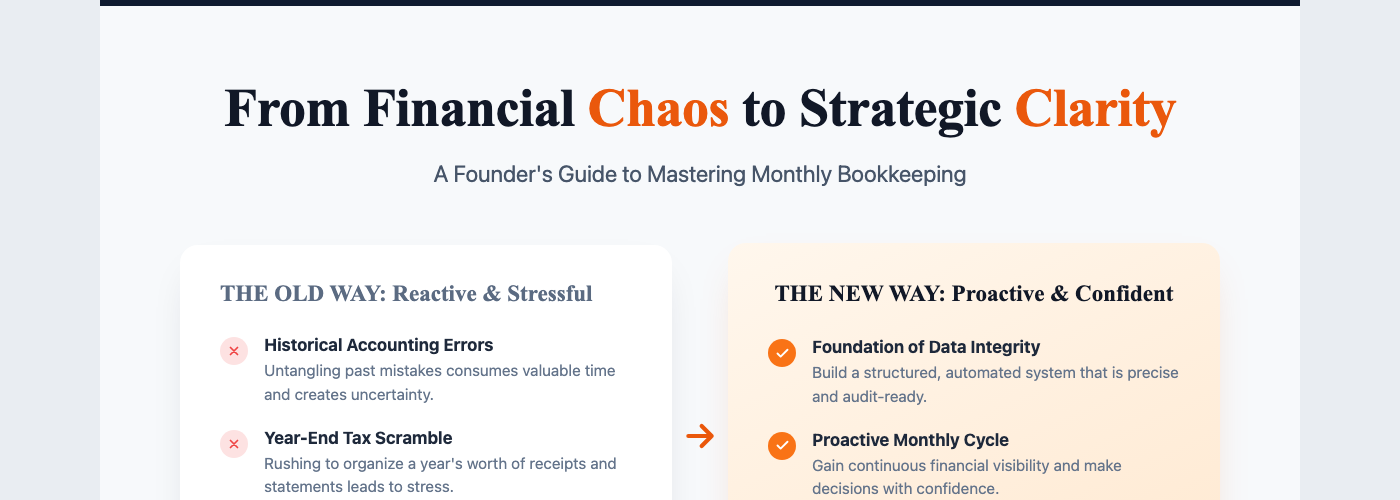
When owners describe their books as a mess, they usually describe three things at once: historical errors nobody has untangled, a year-end scramble to assemble receipts, and no honest read on cash between those two events. Those are not three problems. They are one problem observed at three moments.
We put the whole picture on a single page — From Financial Chaos to Strategic Clarity — because the sequence matters more than any individual fix. It walks the old way against the new one, names the three pillars monthly bookkeeping actually stands on, and gives you the questions to ask anyone you are considering handing your books to.
The three pillars, briefly
Bank reconciliation. Your records matched against the bank's reality, every account, every month. Not a chore — the mechanism that stops a small discrepancy becoming a restatement.
Expense categorization. Every transaction placed where it belongs, so you can see where capital is actually going rather than where you assume it went.
Data integrity. Records precise enough to stand up to outside scrutiny, which is what protects the entity itself when scrutiny arrives.
None of those is glamorous. Together they are the difference between a business you can lead and one you can only react to.
What to ask before you hand over your books
The infographic sets out four tests, and one is non-negotiable: every bank account and credit card balanced against your ledger every thirty days. If a prospective partner treats that as an aspiration rather than a standard, you have your answer.
The others are about fit and about ambition. Is the transaction volume honestly assessed, so you are neither short of coverage nor paying for capacity you will not use? Do they know your tools deeply enough to avoid creating the errors they were hired to prevent? And will anyone actually interpret the numbers with you, or are you buying data entry?
Where to start, if you are starting
Almost always with a cleanup. You cannot build a reliable monthly rhythm on top of records that are already wrong; the rhythm just carries the errors forward faster. Resolve the history, restore integrity, get to an audit-ready state, and then the monthly cycle has something solid to stand on.
After that, the work stops being about bookkeeping at all. It becomes a monthly read on where you stand, what changed, and what to do next — which is the only version of this that was ever worth paying for.
Drawn from The Financial Command Center™, Volume 3 of the Business Navigation Series™, Chapter One: The Purpose of the Financial Command Center.
Not ready to book? Watch The Hidden Cash Leak — a free nine-minute masterclass on where the money actually goes in a profitable business. No sign-up, no pitch until the end.