


What if the financial reports you rely on to run your business are actually steering you in the wrong direction? It's a heavy realization when you look at a profit and loss statement and realize the numbers don't reflect the reality of your bank balance. When reconciliation discrepancies won't go away and transactions seem to vanish into incorrect categories, a professional QuickBooks file cleanup becomes a vital investment in your peace of mind. We know the anxiety that comes with messy data, particularly when you need to be audit-ready or make a high-stakes decision. You shouldn't have to guess where your money is going.
You deserve a financial system that works as hard as you do. In this guide, we'll show you how to identify hidden accounting errors, resolve historical data gaps, and establish a reliable system that stays organized. We'll walk through the strategic process of restoring your data integrity so you can regain total visibility into your business finances. From untangling old mistakes to managing the mandatory shift to modern reporting views, you'll learn how to turn your books into a powerful tool for growth and stability.
Key Takeaways
- Spot the subtle red flags, such as persistent bank reconciliation discrepancies, that indicate your financial records need professional attention.
- Learn why a successful QuickBooks file cleanup focuses on the Chart of Accounts to ensure your financial flow is logical and transparent.
- Identify the "Garbage In, Garbage Out" risks of over-relying on automated bank feeds and AI-generated rules without expert verification.
- Master a strategic workflow that uses the Balance Sheet as an anchor to restore data integrity and provide clear visibility for business decisions.
- Transition from the stress of historical errors to a proactive system of monthly bookkeeping that maintains organization and audit readiness.
Table of Contents
- Signs Your Business Needs a QuickBooks File Cleanup
- The Anatomy of Financial Data Restoration
- Professional Cleanup vs. Software Automation: Why AI Isn't Enough
- A Strategic Workflow for Cleaning Your QuickBooks Online File
- Restoring Integrity with Dexton-Livvy’s Specialist Cleanup Services
Signs Your Business Needs a QuickBooks File Cleanup
Managing a business is a series of critical decisions. When those decisions are based on a compromised financial file, the risk to your company's stability grows. A compromised QuickBooks file doesn't always fail all at once; it decays slowly, one miscategorized transaction at a time. Recognizing the early red flags allows you to take action before the errors become a systemic failure. This process of identifying and correcting corrupted records is a specialized form of Data cleansing that restores the reliability of your entire accounting system.
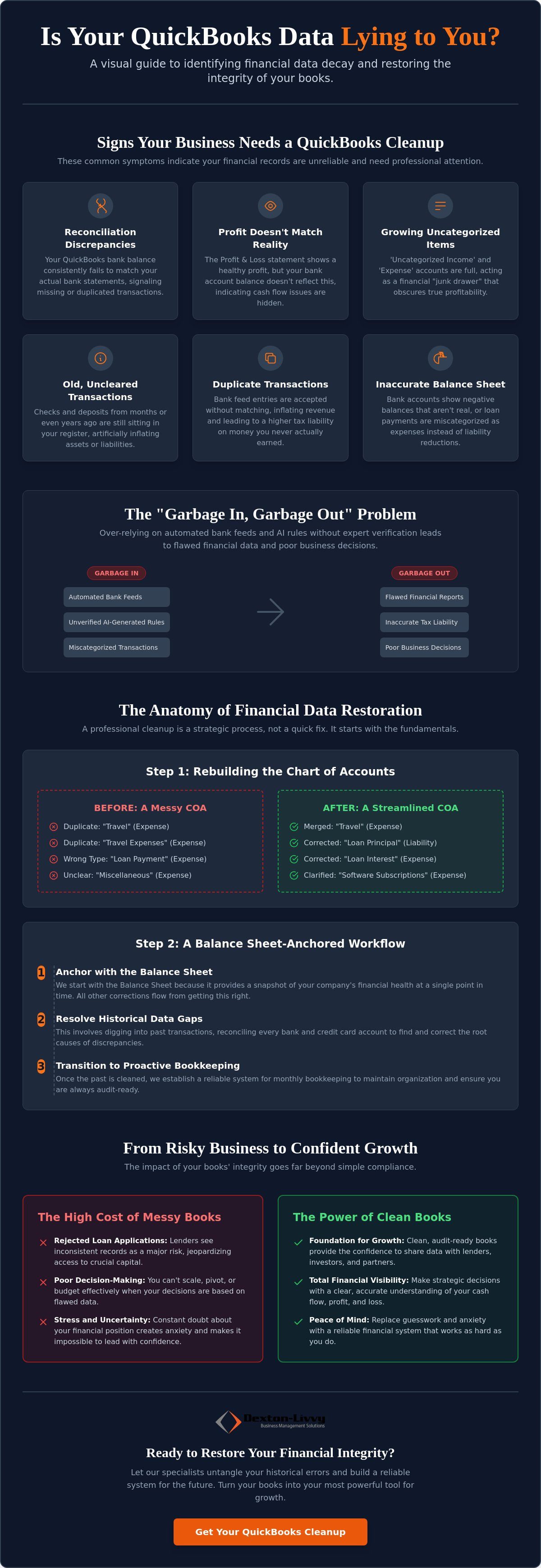
Bank reconciliation discrepancies are often the first sign that your data integrity is failing. If your bank balance in QuickBooks doesn't match your actual bank statement, and you can't explain why, your reports are already unreliable. This isn't just a minor annoyance. It's a signal that transactions are missing, duplicated, or recorded in the wrong period. Similarly, 'Uncategorized Income' and 'Uncategorized Expense' accounts act as a junk drawer for your finances. Every dollar sitting there is a question mark that obscures your true profit and loss. When these accounts grow, your visibility into where your money is actually going disappears.
Duplicate transactions are another silent threat. They often occur when bank feeds are accepted without matching them to existing invoices or bills. These duplicates inflate your revenue on paper, which leads to a higher tax liability. You end up paying taxes on money you never actually earned. A professional QuickBooks file cleanup untangles these overlaps to ensure your tax obligations are based on reality, not clerical errors.
Common Symptoms of Data Decay
Data decay often manifests directly on your Balance Sheet. You might see bank accounts or credit card registers with negative balances that don't reflect your actual holdings. You may also find old, un-cleared checks or deposits from years ago still sitting in your register. These ghost entries inflate your assets or liabilities and make it impossible to see your actual cash position. We look for these specific anomalies to bring your records back into alignment with the truth.
The Strategic Cost of Messy Books
Messy books carry a heavy price tag that goes beyond simple organization. When you apply for a business loan or a line of credit, lenders look for clean, consistent records. If your Profit and Loss statement is flawed, your application might be rejected regardless of your actual success. Beyond lending, the primary cost is poor decision-making. You can't pivot or scale if you're looking at flawed data. Clear data isn't just about compliance; it's about having the visibility to lead your business with confidence. A thorough QuickBooks file cleanup provides the foundation for that growth.
The Anatomy of Financial Data Restoration
A professional QuickBooks file cleanup is more than a simple reorganization; it's a holistic restoration of your business's financial history. Think of it as restoring a vintage map. If the lines are blurred or the landmarks are misplaced, you'll never reach your destination. While many owners attempt "quick fixes" by creating large journal entries to balance accounts, these shortcuts often mask deeper structural issues. True restoration involves digging into the logic of your data to ensure every transaction flows exactly where it should.
Historical data integrity is the foundation of future growth. You can't accurately project next year's budget or analyze your margins if last year's records are fragmented. Ensuring your ledger aligns with professional benchmarks like the AICPA General Ledger Audit Data Standards provides the transparency needed for true accountability. It moves your books from a state of "good enough" to a state of audit-readiness, giving you the confidence to share your data with lenders or partners. If you find these structural issues overwhelming, our QuickBooks Cleanup Services are designed to restore that lost clarity for you.
Reviewing the Chart of Accounts (COA)
The Chart of Accounts is the skeleton of your financial system. Over time, it's common for duplicates to appear, such as having both "Travel" and "Travel Expenses" accounts. We streamline this by merging redundant categories, which simplifies your reporting without losing historical data. We also verify that account types are correct. A common error is listing a loan payment as an expense rather than a liability reduction. Correcting these classifications ensures your Balance Sheet and Profit and Loss statements accurately reflect your business's health.
Untangling the General Ledger
The General Ledger is where the granular work happens. We identify and correct misposted journal entries that can throw off your entire reporting cycle. This process also includes cleaning up your Accounts Receivable (A/R) aging report. It's common to find "stale" balances where payments were received but never matched to the original invoice. We also resolve old Accounts Payable (A/P) balances that may have been paid outside of the system. Restoring these relationships is the most technical phase of a QuickBooks file cleanup, but it's the only way to ensure your financial reports reflect the truth.
Professional Cleanup vs. Software Automation: Why AI Isn't Enough
Modern accounting software offers a tempting promise: total automation. While AI and bank feeds are powerful tools, they lack the contextual intelligence required to maintain true data integrity. In many cases, these features actually accelerate the decay of your financial records. If a transaction is incorrectly mapped once, the software's "learning" algorithm often applies that same error to every future instance. This creates a "Garbage In, Garbage Out" cycle where errors multiply quietly in the background. A professional QuickBooks file cleanup is necessary because software cannot identify its own logic failures. It takes an expert mentor to look past the automated suggestions and see the actual business reality behind the numbers.
Software is excellent at following rules, but it's poor at understanding intent. For example, if you set up a bank rule to categorize all transactions from a specific vendor as "Office Supplies," the AI will do exactly that. It won't realize that a one-time large purchase from that same vendor was actually a capital asset that should be depreciated. Without human oversight, your tax liability and asset tracking become skewed. We often find that business owners who rely solely on automation end up with thousands of miscategorized transactions that require a deep, manual QuickBooks file cleanup to resolve. Software doesn't know your business strategy; it only knows your patterns.
The Limits of QuickBooks Automation
QuickBooks automation is designed for speed, not nuance. It frequently struggles to distinguish between personal reimbursements and legitimate business expenses. If you accidentally use a business card for a personal meal, the AI might automatically categorize it as "Meals and Entertainment" based on your previous behavior. These small slips hide deeper issues and can even mask fraudulent activity or simple entry errors. Relying on software suggestions during complex reconciliations often leads to "plug" entries that balance the register but ignore the underlying truth of the transaction.
The Value of a Professional Bookkeeping Partner
We act as a steady, reliable hand to guide you through the noise of automated data. A partnership-oriented approach means we don't just fix the errors; we help you understand why they happened so they don't return. Our role is to provide the calm authority needed to resolve financial chaos and ensure your records are truly audit-ready. Software can't provide that level of professional reassurance. By choosing an expert-led cleanup, you're investing in a system that software alone cannot guarantee. We identify the subtle patterns, like vendor overpayments or missed credits, that AI simply overlooks.
A Strategic Workflow for Cleaning Your QuickBooks Online File
A successful restoration requires a methodical order of operations. You can't simply jump into the middle of a messy year and expect clarity. Instead, we establish a logical sequence that anchors every correction to the truth of your bank statements. In 2026, with QuickBooks Online moving exclusively to modern view reports, having a structured approach is more important than ever to ensure your data remains accessible and clear. A professional QuickBooks file cleanup starts with the Balance Sheet because it serves as the anchor for your entire system. If your assets and liabilities aren't verified, your profit and loss statement is merely a series of guesses.
We begin by establishing a definitive cut-off date. This prevents us from chasing errors into the infinite past and allows us to focus on restoring integrity to the periods that matter most for your current decision-making. We also verify opening balances and equity accounts to ensure the starting point of your data is sound. If your historical data feels like a tangled web, our QuickBooks Cleanup Services provide the expert oversight needed to untangle it correctly.
Phase 1: Diagnostic and Discovery
Diagnostic work is the first step toward stability. We run Trial Balance and Transaction Detail reports to look for anomalies that indicate systemic issues. By identifying the specific months where data decay is most prevalent, we can prioritize our efforts effectively. We document every known error before making a single change. This creates a transparent roadmap for the restoration and ensures nothing is overlooked during the execution phase.
Phase 2: Execution and Reconciliation
Reconciliation is the heartbeat of financial accuracy. We reconcile every bank and credit card account to the penny, ensuring that the digital record matches the physical reality. This phase includes cleaning up the 'Undeposited Funds' account, which often becomes a "black hole" for forgotten payments. We also review and adjust the 'Opening Balance Equity' account to remove the "plug" entries that often hide historical errors. This methodical scrubbing is what turns a confusing file into a reliable management tool.
Phase 3: Verification and Closure
The final phase ensures that your hard-won clarity stays protected. We lock the books with a closing date password to prevent accidental changes to the restored periods. We also compare the restored data to your previous tax returns to ensure consistency and compliance. Data integrity is the alignment of digital records with physical bank statements. By following this structured workflow, you move from financial anxiety to a state of total visibility and control.
Restoring Integrity with Dexton-Livvy’s Specialist Cleanup Services
Reclaiming control over your financial data is a transformative moment for any business owner. The transition from the anxiety of messy records to the stability of a clean file allows you to shift your focus from past errors to future opportunities. Dexton-Livvy LLC serves as a steady, reliable hand in this process. We don't just act as a passive service provider. We function as an active partner in your operational success. By choosing a professional QuickBooks file cleanup, you're moving into a state of professional reassurance where every number on your report serves a strategic purpose.
Our firm operates with a remote-focused advantage, which allows us to provide expert oversight to businesses across the United States. Distance doesn't limit the depth of our partnership. We use secure, cloud-based tools to bridge the gap and ensure you have access to top-tier accounting expertise regardless of your physical location. This accessibility ensures that your data remains accurate, transparent, and ready for any high-stakes decision or audit that comes your way. Clarity isn't a one-time event; it's a standard we help you maintain.
Our Partnership-Oriented Cleanup Process
We believe that a successful restoration requires a collaborative review of your historical accounting discrepancies. Our process begins with transparent communication to eliminate the administrative anxiety that often accompanies messy books. We don't use generic templates. Instead, we develop customized cleanup plans tailored to your specific business needs and transaction volume. This personalized attention ensures that we address the root causes of your data decay, rather than just treating the symptoms. You'll gain a better grasp of your own data through our expert guidance and mentorship.
Beyond the Cleanup: Maintaining Excellence
A thorough QuickBooks file cleanup provides a clean slate, but maintaining that excellence requires ongoing discipline. Our Monthly Bookkeeping Packages are designed to prevent future data decay by providing consistent, professional oversight. We also offer Payroll Coordination Services to ensure your team is paid with administrative ease and accuracy. This comprehensive approach removes hidden obstacles to your growth and gives you the visibility needed to scale your business confidently. When your books are organized, your path to expansion becomes clear and predictable.
Restore your financial clarity with Dexton-Livvy's QuickBooks Cleanup Services and experience the confidence that comes with total data integrity.
Reclaiming Your Financial Clarity
The burden of historical accounting errors doesn't have to hinder your business's future. You've seen how identifying systemic red flags and following a methodical workflow can transform a compromised file into a reliable strategic asset. While automation provides a baseline of efficiency, it's the professional judgment of an expert mentor that ensures your reports are truly audit-ready. Restoring your data integrity is the essential first step toward making the confident, data-driven decisions that fuel long-term scalability.
Dexton-Livvy LLC provides the calm authority you need to resolve complex historical accounting discrepancies and establish a foundation of stability. Our remote-focused service model allows us to support business owners across the nation, integrating professional payroll coordination and monthly bookkeeping to ensure your system stays organized. We move beyond passive service to become an active partner in your operational success. You don't have to navigate financial chaos on your own during a QuickBooks file cleanup.
Schedule your QuickBooks file cleanup consultation with Dexton-Livvy today. Let's work together to eliminate administrative anxiety and build a financial system that supports your vision for growth. You're closer to total visibility than you think.
Frequently Asked Questions
How long does a typical QuickBooks file cleanup take?
The duration of a project depends on your transaction volume and the number of years requiring restoration. A standard cleanup covering a few months of data often concludes within two to three weeks. More complex cases involving multi-year reconciliations or structural changes to the chart of accounts require a longer timeline to ensure total accuracy and data integrity.
Can I still use QuickBooks while a cleanup is in progress?
You can continue your daily operations, but we recommend a coordinated approach to avoid duplicating efforts. We typically establish a specific cut-off date for historical corrections. While we work on restoring the integrity of past periods, you can continue entering current transactions. We provide clear guidance on which areas to avoid touching to maintain a smooth restoration process.
Why does my QuickBooks balance not match my actual bank balance?
Discrepancies usually stem from duplicate entries, missing transactions, or uncleared checks that haven't been reconciled. If you've accepted bank feed suggestions without matching them to existing records, you likely have inflated balances. A professional QuickBooks file cleanup identifies these specific overlaps and removes the ghost entries that obscure your actual cash position and profit margins.
What documents do I need to provide for a professional cleanup?
We require access to your bank and credit card statements, loan documents, and previous tax returns. Having these physical records allows us to verify that your digital ledger aligns with reality. We also look for any payroll reports or merchant statements that might explain uncleared deposits or mysterious transfers that have cluttered your General Ledger over time.
Is it better to clean up an old file or start a brand-new QuickBooks company?
Cleaning an existing file is generally preferred because it preserves your historical data and vendor relationships. Starting fresh sounds simple, but it often creates a data island that makes year-over-year reporting impossible. We only recommend a new file if the existing data is so corrupted that the structural integrity cannot be restored through standard cleanup methods.
How often should a business perform a data integrity check?
You should perform a high-level check every month during your reconciliation process. A more thorough diagnostic review is beneficial at the end of each quarter to ensure everything remains aligned. Regular oversight prevents small errors from snowballing into systemic failures. Consistent maintenance ensures your books remain audit-ready and provides the clarity needed for proactive business scaling.
What is the difference between cleanup and regular monthly bookkeeping?
A cleanup is a one-time restoration of historical data, while monthly bookkeeping is the ongoing maintenance of current records. Think of a cleanup as a deep structural repair to your financial house. Monthly bookkeeping is the regular upkeep that ensures the house stays in top condition. Many clients transition to our monthly packages immediately after their QuickBooks file cleanup is complete.
Can a professional cleanup help me if I haven't reconciled in years?
We specialize in untangling multi-year data gaps and restoring lost visibility for business owners. Even if you haven't reconciled in several years, we can systematically work through each period to bring your balances into alignment. We use your historical statements as our source of truth to ensure every transaction is eventually accounted for and correctly categorized for tax compliance.
Not ready to book? Watch The Hidden Cash Leak — a free nine-minute masterclass on where the money actually goes in a profitable business. No sign-up, no pitch until the end.